
Reshoring manufacturing is becoming a hot topic.
Between supply chain disruptions, rising costs, and an increased focus on quality and part complexity, companies are starting to rethink where their parts come from.
For a long time, offshore production seemed like the right choice, especially for high-volume production machining. The parts initially appeared cheaper, and for simpler jobs, that might have been sufficient. However, for teams focused on tight-tolerance, complex machined parts, the trade-offs are becoming increasingly difficult to ignore.
The supply chain chaos that started in 2020 made it clear: the real cost of offshore production goes far beyond what’s printed on a PO. Long lead times, communication breakdowns, and basic quality issues can quickly consume time and money. And now, with tariffs at the forefront, reshoring manufacturing is gaining even more traction.
At Wagner Machine Company, we’re seeing firsthand more customers asking whether to bring high-volume production back to the U.S. Our opinion? Bringing CNC precision machining work closer to home just makes sense.
Why More Teams Are Rethinking Offshore
Many customers don’t begin exploring reshoring until they’ve had a bad experience offshore. All it takes is one significant failure, like a late shipment, unresolved quality issue, or unexpected part shortage, and they start to see the real expenses of the entire offshoring model.
Here are a few of the key reasons customers are pushing to reshore part of their manufacturing process:
Logistics and Lead Time Challenges
When you’re sourcing parts offshore, you’re often required to purchase 6–12 months’ worth of inventory at once. That ties up valuable capital, fills warehouse space, and limits your ability to react if demand shifts or engineering changes come up mid-cycle. By the time those parts arrive, they may already be outdated.
Even when shipping goes smoothly, customs delays and transit inconsistencies can cause serious disruption in the form of shortages one month and overstock the next. For teams managing tight production schedules, these logistical risks can quickly outweigh any upfront cost savings.
Limited Visibility and Control
One of the biggest challenges with offshore production is the lack of transparency. Customers often don’t know who exactly is making their parts because they’re working through brokers who manage a network of overseas shops. Yet the broker is their only point of contact. This can lead to inconsistency from batch to batch and you might not know about it until months after the parts have been made.
That setup makes it hard to trace materials, confirm secondary processes, or get clear answers when something goes wrong. Even when suppliers provide details, confidence can be low, and customers are left wondering if the information is accurate.
Quality and Communication Issues
Most part quality problems stem from common issues such as burrs, tolerance deviations, or inconsistent finishes. And while those might not sound dramatic, they can cause major problems at scale, especially with high-volume production and complex machined parts.
What makes it worse is that when something does go wrong, communication can be slow or unclear, making resolution feel impossible. You’re dealing with time zone differences, language barriers, and suppliers who may not have the necessary systems or responsiveness. And when those small issues show up across a year’s worth of parts, the costs add up fast. Beyond rework, you’re looking at lost time, downstream delays, and frustrated teams across the board.
What You Gain with Reshoring
Bringing production closer to home offers more than just peace of mind. For teams managing complex machined parts or fast-moving product lines, reshoring manufacturing opens the door to faster feedback loops, better quality control, and clearer communication. The part may “cost” more on paper, but the overall costs are often comparable if you consider all the hidden costs of offshoring. We have heard from some customers that 30%-50% price increases actually save them money in many cases.
Greater Agility and Flexibility
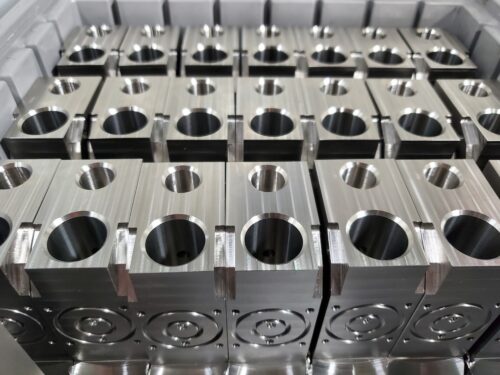 Offshore production often requires large, one-time orders that can’t be adjusted once they’re in motion. At Wagner Machine Company, the process works differently. Blanket POs cover up to 12 months of parts, with flexible delivery schedules and stocking agreements that provide customers with what they actually need, without tying up capital in oversized inventory.
If something changes, we can adjust mid-run. Minor revisions or finish preferences can be updated on the fly. New revisions can be tested on production equipment with production procedures at minimal cost. That level of flexibility is difficult to match with overseas suppliers, especially when you’re dealing with complex machined parts and fast-moving production cycles.
Transparent Quality and Traceability
At Wagner, we’re perfectionists about part quality. Yes, our ongoing quality checks ensure that parts pass inspection, but they also give customers confidence that they’re getting exactly what they need. We routinely inspect beyond what’s required to reduce risk on both sides.
Traceability is also built into our process. Material certs, anodizing, plating, and other secondary operations are tracked, even when that isn’t formally requested. That kind of transparency is hard to get with offshore production, especially when you don’t know exactly who made your parts or how they were handled.
Real-Time Communication and Accountability
One of the biggest differences with reshoring is how easy it is to get answers. At Wagner, customers work directly with the team that makes their parts, not through a broker or third-party representative. That’s a big deal when you’re working with complex machined parts or tight CNC precision machining specs.
Being in the same time zone, or close, makes communication faster and more straightforward. If a question comes up, whether it’s about a finish, a tolerance, or supporting documentation, you know exactly who to call (and the person on the other end actually knows your parts).
Reshoring Manufacturing Is About More Than a Price Tag
At Wagner Machine, we take a proactive approach to every part that runs through our shop: inspecting beyond what’s required, flagging features that could cause issues, and maintaining customer preferences through thorough internal documentation.
In one case, a customer asked if we could improve the finish on a part that was technically in spec. We asked for the request in writing, and then updated our internal process on the spot to make sure future batches reflected their preference. Prints and inspection sheets were all updated with no delays waiting on an engineering change.
That combination of flexibility and proper documentation isn’t possible when you’re working with offshore vendors. But with a local partner who knows your parts inside and out, small decisions add up to big long-term gains in quality, consistency, and customer satisfaction.
Offshore production might look cheaper upfront, but when you factor in delays, communication gaps, quality issues, and extra inventory, the real cost tells a different story.
Reshoring gives you more control, more confidence, and a partner who’s ready to adapt as your needs evolve. Ready to bring your parts closer to home? Request a quote to learn how Wagner can support your reshoring goals at our precision machine shop.