
We’re struggling with a large part right now. Our team will get it done (we always do) but it’s taking longer and requires different problem-solving than parts in our typical size range. Some of our usual tricks don’t quite work, and we’re running into machine limitations we rarely encounter.
This is exactly how shops specializing in large parts feel about small ones. The difference is that many of them don’t even realize they’re struggling—or how much that struggle is costing their customers.
At Wagner Machine Company, small, complex machined parts are our specialty. It’s what our team and equipment are built for. Compared to a general CNC machine shop, you can expect faster cycle times, better part finish, improved consistency, and lower costs by working with a 5-axis machine shop or Swiss machine shop that’s optimized for small, complex parts.
The Hidden Cost of Mismatched Equipment
Many machine shops default to buying the biggest machine they can afford or fit in their facility. The thought process often goes like this: “If a machine that is 50% larger only costs 20% more—why not get the bigger one and have increased capacity?”
The result is general-purpose equipment that can do a little bit of everything but isn’t optimized for any specific size range. When shops use large-part equipment to make small, complex machined parts, costs creep up due to many compounding inefficiencies. Poor workholding, low spindle speed, slow tool changes, slow pallet changes, material waste, additional programming and setup time, all lead to longer cycle time and increased cost.
For buyers and engineers with existing supplier relationships, consolidating parts of all sizes with one shop simplifies the purchasing process. General machine shops often trudge through jobs for small parts without complaint or they outsource to a specialty shop like Wagner Machine. We’re happy to partner with another shop or do the work directly with an end customer, but for high-volume machining, a 15-30% markup is a steep price to pay for a slightly streamlined purchasing process.
Why Machine Size Matters
When you’re making thousands of parts, every second matters, and smaller machines are optimized to shave off time in multiple ways.
For small turned parts, Swiss machining services offer multiple optimizations over conventional twin spindle lathes. Spindle speeds up to 12,000rpm decrease cutting time. Other features like gang tooling, shorter travel distances, higher rapid speeds, single second part load, and no part unload time reduce non-cutting time.
The single biggest time savings on short cycle time parts is sub spindle transfer. On a conventional twin spindle lathe, transferring a part from the main spindle to the sub spindle takes 15-25 seconds. A Swiss machine does it in 5-10. We have machined complete parts on Swiss machines in less time than a conventional lathe can transfer from the main to the sub spindle. The efficiency of the Swiss turning process is hard to ignore for small parts!
We see the same pattern with 5-axis machining services. Years ago, we ran a part with a 12-minute cycle time on a standard 5-axis mill. That doesn’t sound bad for a complex part until you hear the next statistic – over 8 minutes of that was tool changes! We only spent 4 minutes actually cutting the part.
Our high speed 5-axis mills are optimized for small parts. 20,000rpm spindles, chip-to-chip tool changes in less than 3 seconds, direct drive rotary axes, and sub 15 second robotic loading drastically reduce non-cutting time. We can make many parts in less than 50% of the cycle time of a conventional 5-axis mill, and we can run consistent, high-quality, unattended production all night!
Small Parts Require Different Skills
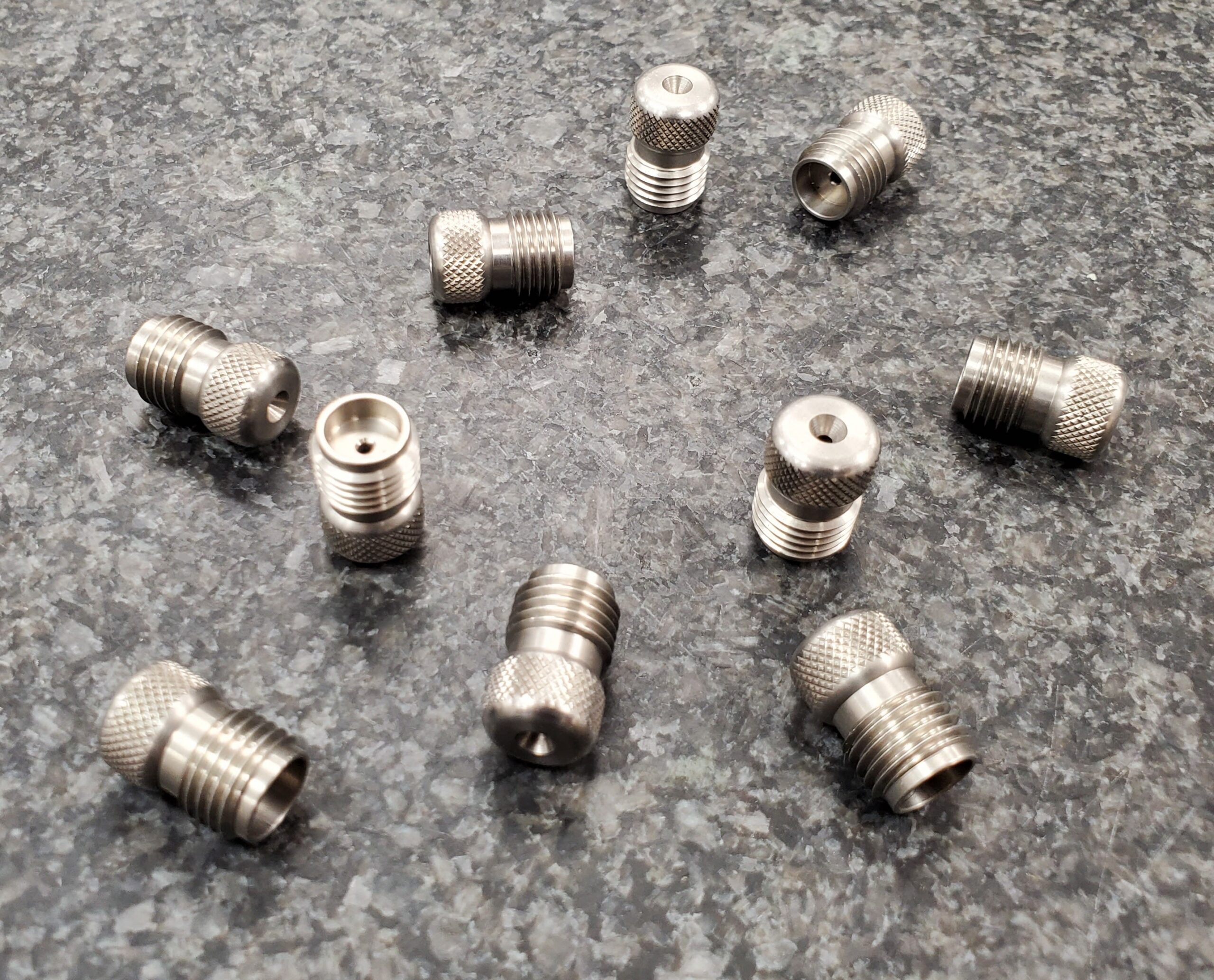
There’s a real learning curve with parts this small. The smaller the part, the less material there is to hold, which makes fixturing tricky. You’re also working with tighter clearances and more delicate tooling.
Even machinists with 5-10 years of experience creating complex machined parts often haven’t worked at this scale until they join our team.
Our expertise also means we’ve built a deep tooling library with over 500 types of tools under ¼” diameter, with multiples of each on hand. That means we can jump straight into production without waiting on specialty tooling, and if something breaks, we don’t lose days waiting for replacements.
When to Consider a Small-Part Specialist
If you have turned parts under 1″ diameter or milled parts smaller than a 6″ cube, it’s worth talking to a shop that specializes in this work.
At Wagner Machine, we offer 5-axis machining services and Swiss machining services specifically optimized for small, complex machined parts. We’re ISO certified, AS9100 certified, ITAR registered, and CMMC Level II self certified.—meeting the requirements for most vendor qualification processes.
We also pride ourselves on being easy to work with. Our onboarding takes about ten minutes, and we’re comfortable navigating more complex qualification requirements when needed.
Bigger machines aren’t better or worse, they’re just built for different work. If you have small parts, it’s worth asking whether your current supplier is truly optimized for them (or quietly subbing the work out to someone like us). Reach out anytime to start a conversation.